What is this property worth?
Three approaches reconciled into a range, structured to IVS 106, priced against the figure the Land Office will use.
10 credits · One tier, one method. The figures are computed, so there is no cheap version
Asking sits 33.2% below the indicative value. Worth understanding before you negotiate.
Three approaches, run in the time it takes to read one
The desk-based part in minutes, and it is explicit about the part it cannot do.
- 01
Describe the property
Location, type, floor area, land area, bedrooms, age. Land area matters more than people expect. Without it the cost approach cannot run.
- 02
Evidence is gathered
Comparable listings are fetched and ranked by how closely they resemble the subject, and the district rent and yield data on file is matched to the asset class.
- 03
The value is computed
Each approach runs, or refuses and says why. What is left is weighted into a range, and only then is the model asked to write the report around it.
No card required to start. Nothing is charged until you run an analysis.
Three approaches, reconciled and weighted
Weighted by how much evidence each approach actually had. One that cannot run drops out and says why.
Income
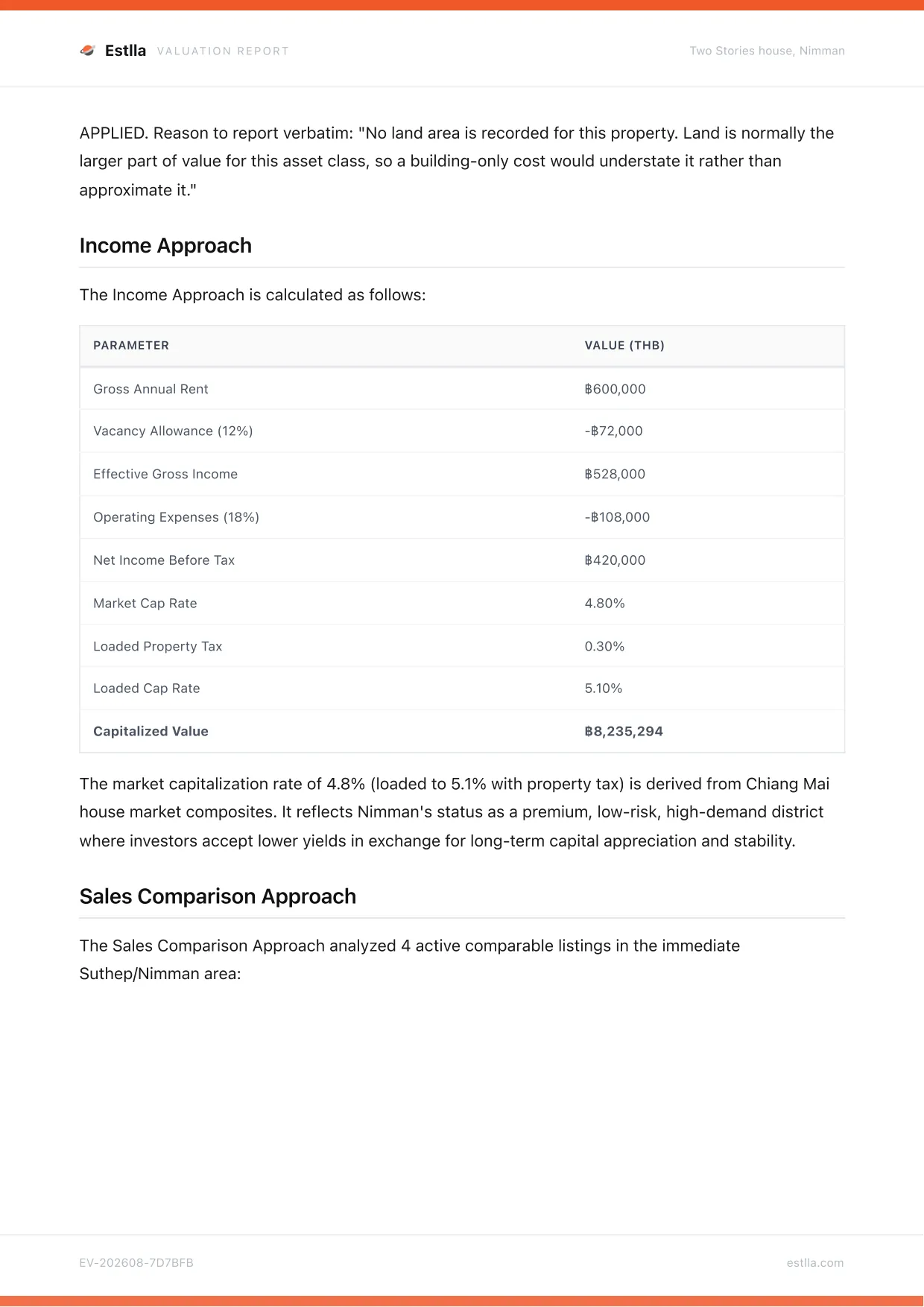
NOI ÷ (cap rate + property tax)Stabilised net income capitalised at the market rate for the district. The property tax rate loads the capitalisation rate rather than the income, so the asking price never leaks into the estimate meant to test it.
Sales comparison
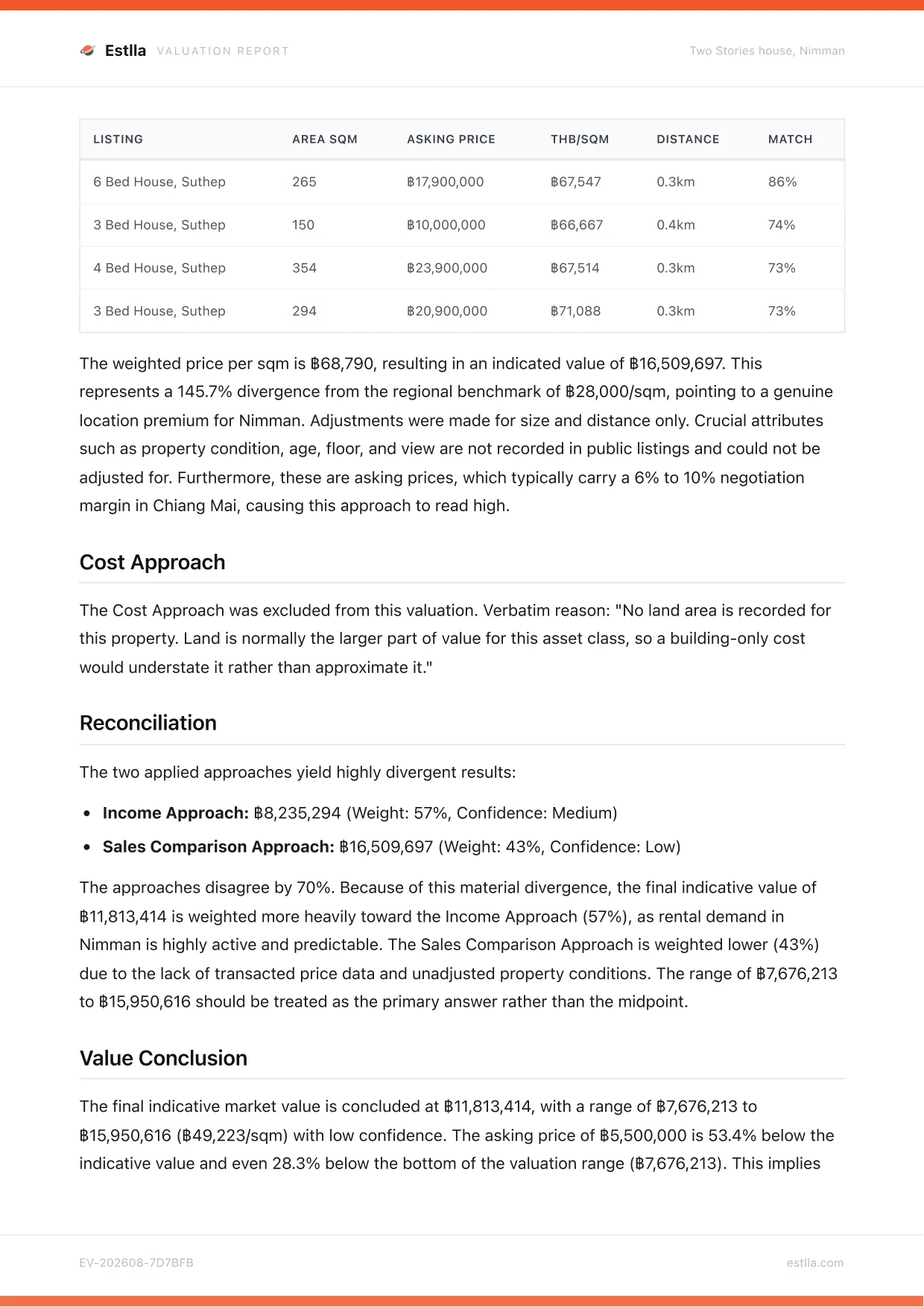
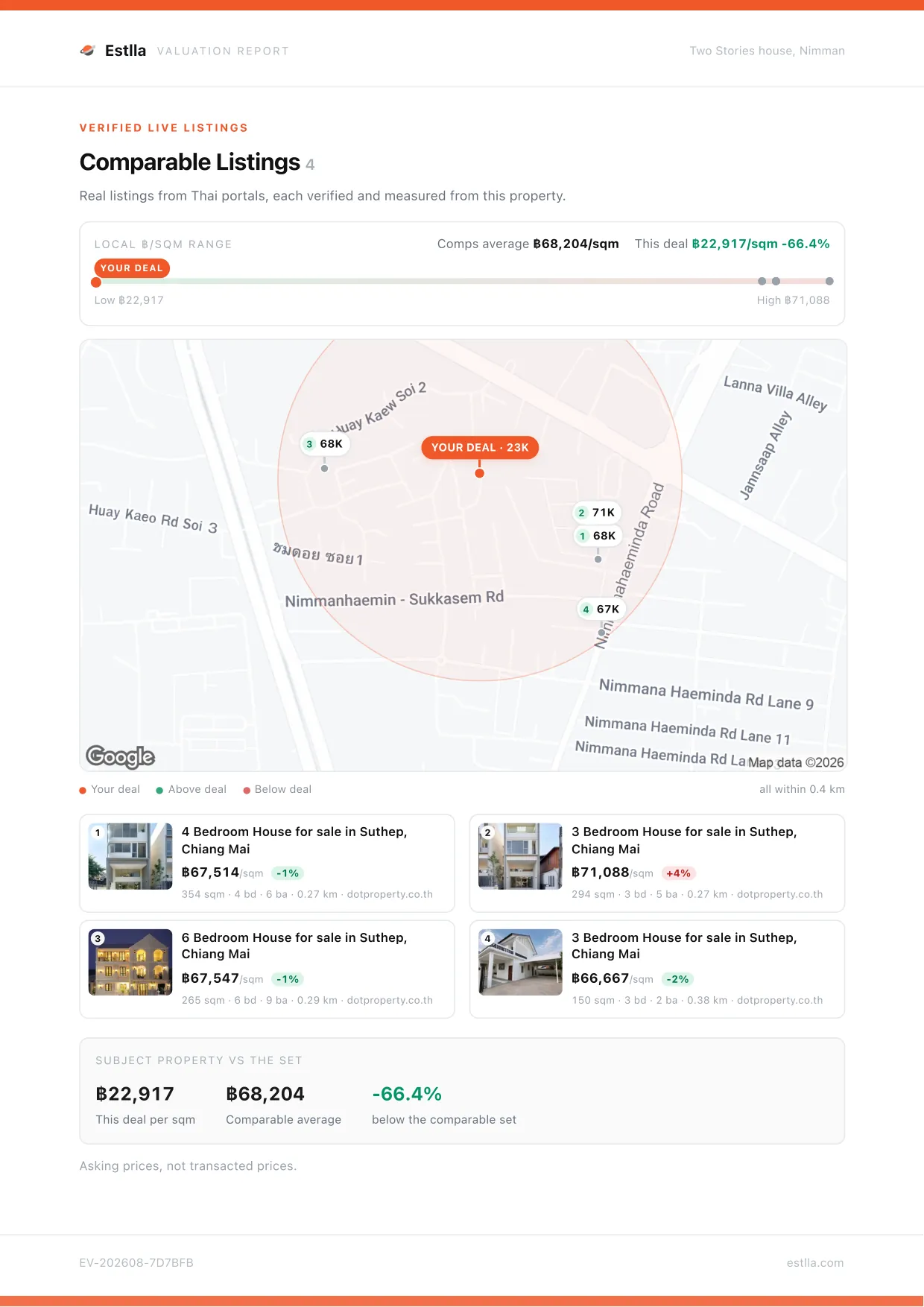
฿/sqm × area, adjusted for differenceComparables ranked by how closely they actually resemble the subject: asset class, floor area, bedrooms, bathrooms, land and distance. Not simply by which listing was nearest.
Cost
land value + depreciated build costLand value plus depreciated replacement cost. For a house with no recorded land area the approach refuses rather than reporting the structure alone, because land is usually most of the value.
The number the Land Office actually charges on
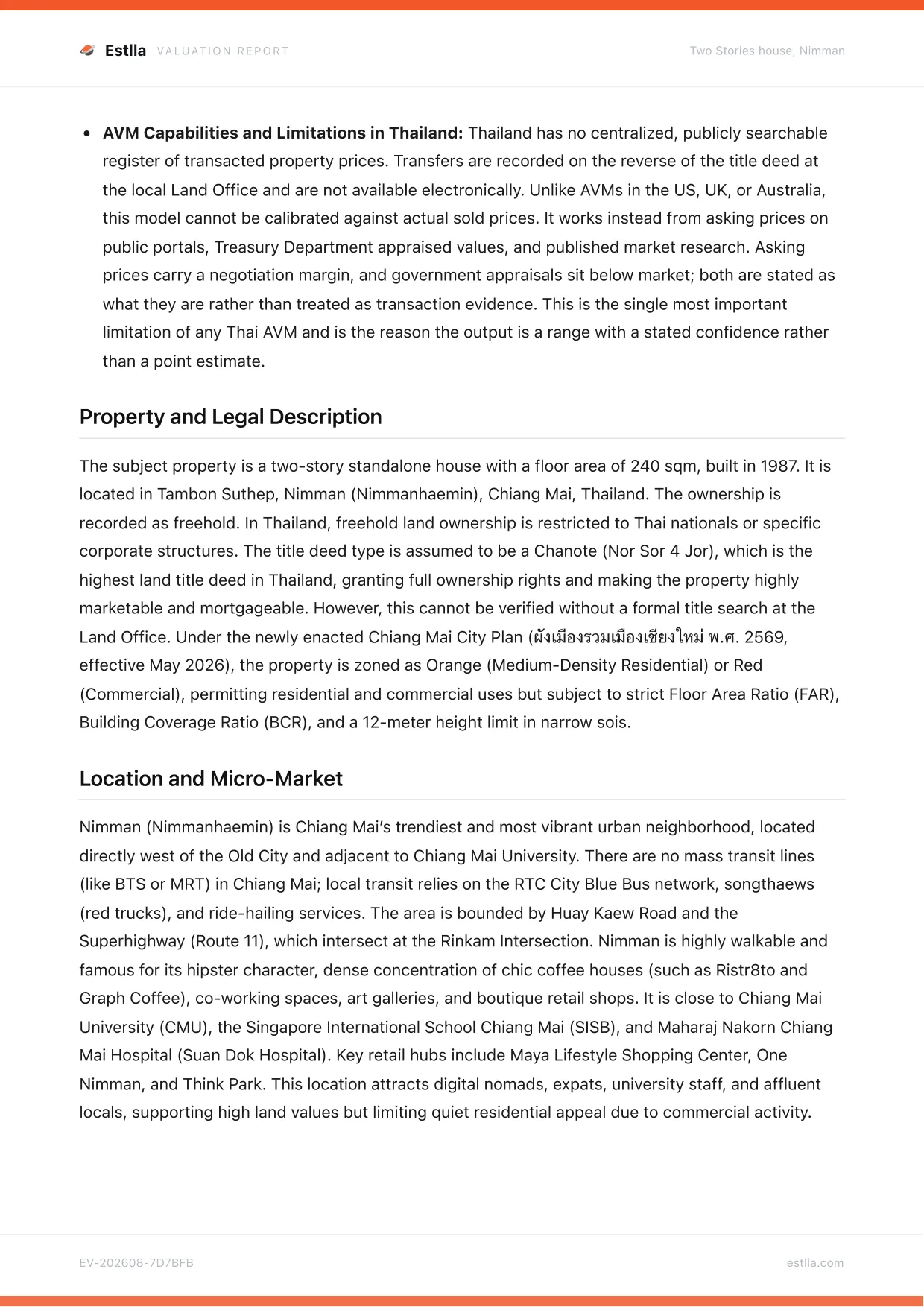
Transfer costs are computed on the Treasury Department appraised value, not on what you pay. Every report carries all three figures side by side.
Government appraised values typically run 20–40% below market and reset on a four-year cycle. The next is in 2027.
This is the actual product, not a mockup
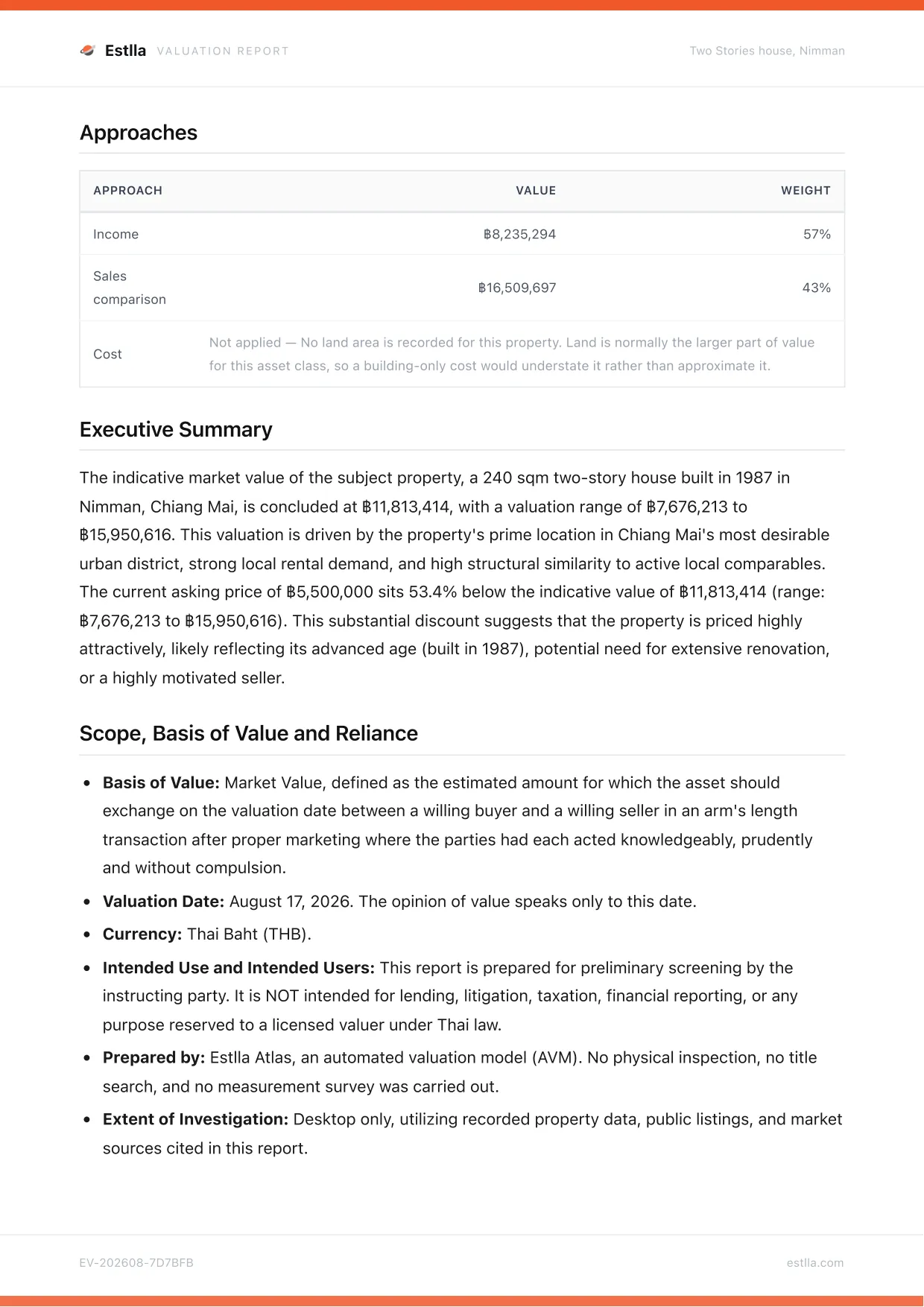
A real run on a Chiang Mai house. Two of the three approaches were excluded, and it says so.
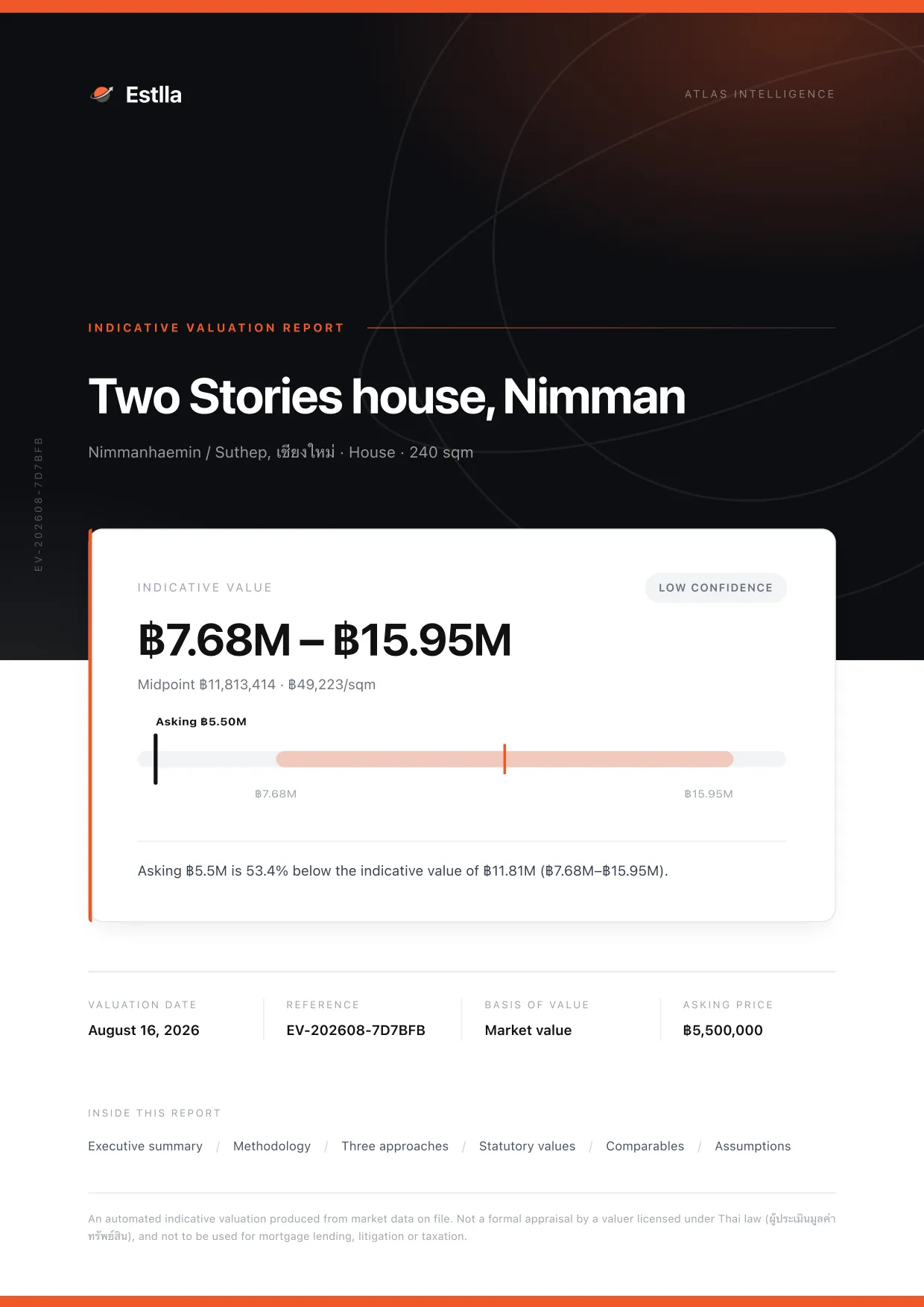
Indicative valuation
Low confidenceMidpoint ฿8.24M · ฿34,314/sqm
Asking ฿5.5M is 33.2% below the indicative value of ฿8.24M (฿7.25M–฿9.22M).
The comparable listings average ฿74,036/sqm against a benchmark of ฿28,000/sqm for this asset class and region (164% above). A gap that wide means they are almost certainly a different kind of property from the subject, so they were not used.
No land area is recorded for this property. Land is normally the larger part of value for this asset class, so a building-only cost would understate it rather than approximate it.
An automated estimate from market data on file. Not a formal appraisal by a valuer licensed under Thai law, and not suitable for lending or other regulated purposes.
- 01Executive summary
- 02Scope, basis of value and reliance
- 03Property and legal description
- 04Location and micro-market
- 05Market conditions
- 06Statutory values and transfer costs
- 07Valuation methodology
- 08Income approach
- 09Sales comparison approach
- 10Cost approach
- 11Reconciliation
- 12Value conclusion
- 13Sensitivity
- 14Assumptions and limiting conditions
Exportable as a PDF with a cover page.
Built to a standard, and clear about its limits
An analysis is only worth what its method is worth. Here is the method, and the honest edges of it.
Structured to IVS 106
The international standard for valuation reporting sets out what a report must convey. Every valuation states its basis of value, the valuation date, intended use and intended users, the approaches applied, the significant inputs, and its assumptions and limiting conditions.
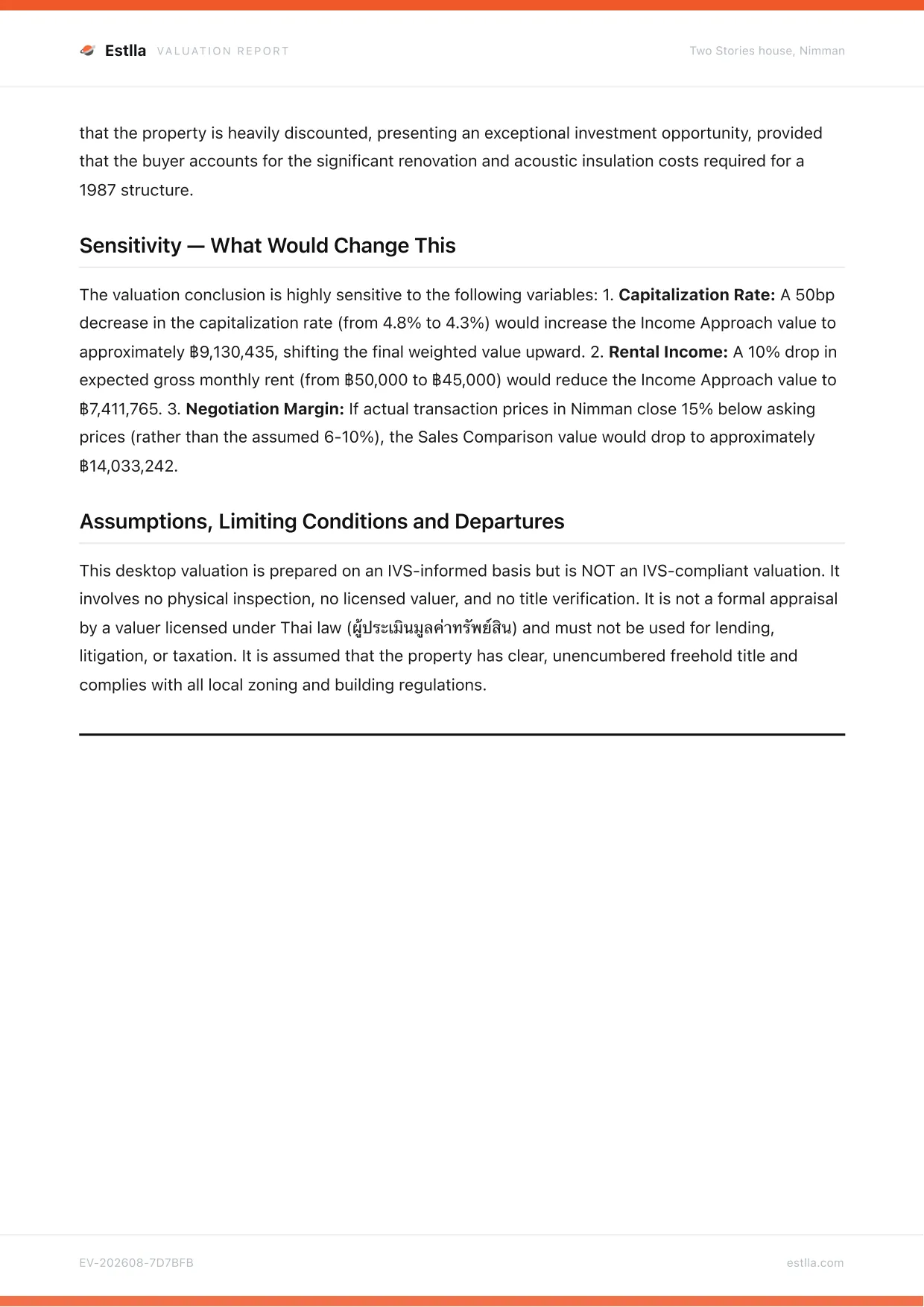
Informed by IVS, not IVS-compliant: there is no inspection, no licensed valuer and no title search.
An automated valuation model
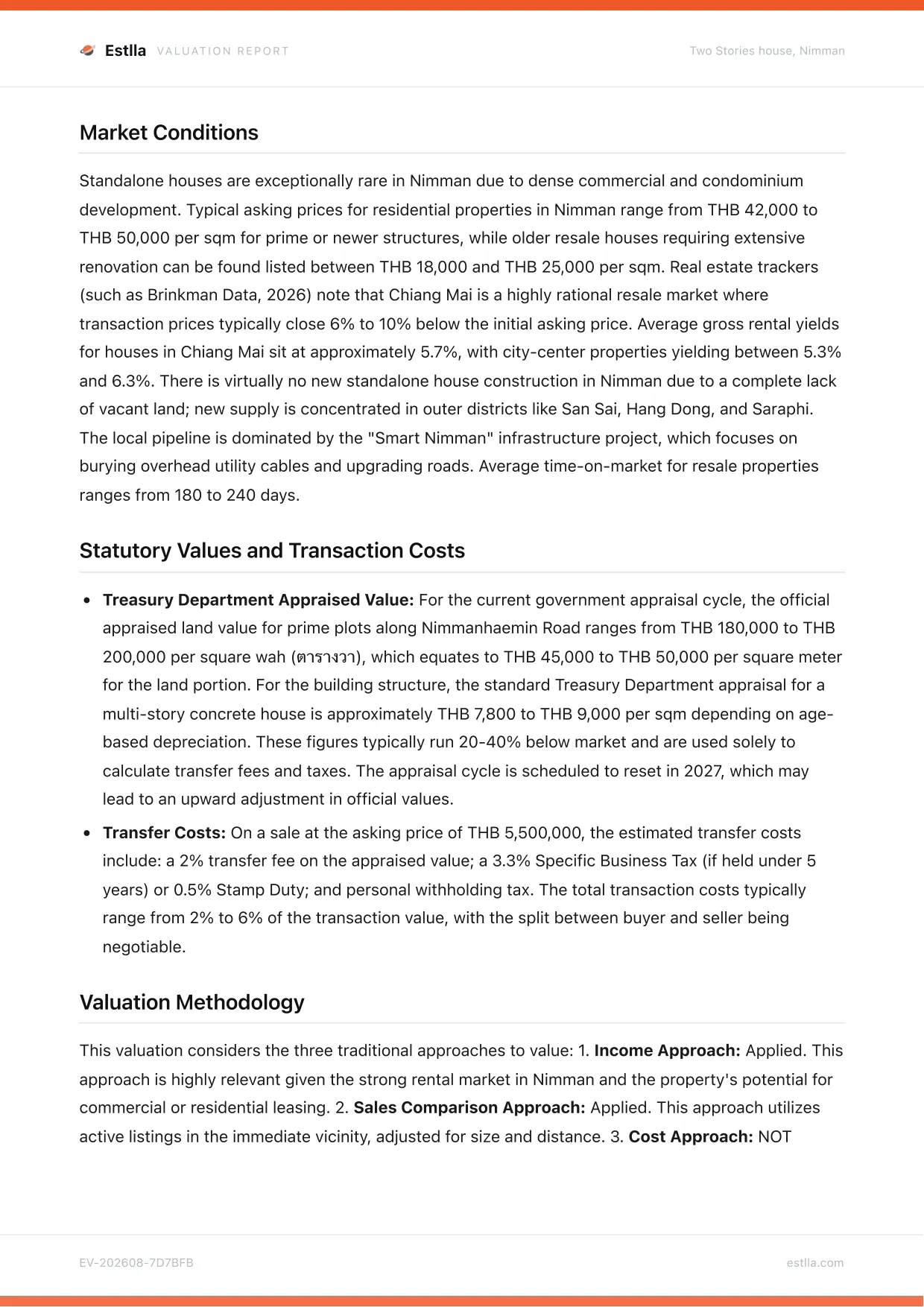
Thailand has no centralised, publicly searchable register of transacted prices. Transfers are written on the reverse of the title deed at the local Land Office. So this model is calibrated against asking prices, the Treasury Department appraised value and published research, and it reports a range with a stated confidence rather than a single number.
Asking prices carry a negotiation margin and government appraisals sit below market. Both are labelled as what they are.
Thai statutory content
Every report carries the Treasury Department appraised value (ราคาประเมินกรมธนารักษ์) for the location, the transfer-cost stack a sale would actually incur, the title deed grade and what it means for mortgageability, and the ownership route open to a foreign buyer.
Transfer fee and specific business tax are computed on the government appraised value, not the sale price.
Estlla produces automated indicative valuations and investment analysis. It is not a formal appraisal by a valuer licensed under Thai law (ผู้ประเมินมูลค่าทรัพย์สิน), and must not be used for mortgage lending, litigation or taxation.
One tier, because there is nothing to upsell
Three approaches reconciled, the fourteen-section IVS-structured report, the statutory figures and a PDF with a cover page.
There is no cheap version and no premium one because the figures are computed rather than reasoned about. A longer model pass would not change the arithmetic. Re-run a property as often as you like; you are charged for the run.
Frequently asked questions
No, and it does not pretend to be. It is an automated valuation: no site inspection, no title search, and no valuer licensed under Thai law (ผู้ประเมินมูลค่าทรัพย์สิน) signing it. It cannot be used for mortgage lending, litigation or taxation. What it is good for is knowing where a price sits before you commit time and money to the formal route.
Correct. Transfers are written on the reverse of the title deed at the local Land Office and are not centrally searchable. So the model works from asking prices, the Treasury Department appraised value and published institutional research, and it labels each for what it is: asking prices carry a negotiation margin, and government appraised values sit 20–40% below market. That is also why the output is a range with a stated confidence rather than one number.
Because it did not have the evidence to run, and saying so is more useful than a number produced from nothing. Sales comparison drops out when the available comparables are a different kind of property from yours. Cost drops out when no land area is recorded, since land is usually most of the value and a building-only figure would understate rather than approximate it. The report always names the reason.
No. Every figure (the three approach values, the weights, the reconciled range and the comparison against the asking price) is computed from stored market data before the model is called. The model is given the completed numbers and asked to explain them. It cannot move a value, which is why running the same property twice gives you the same range.
It is the international standard for what a valuation report must convey, and it is the structure every report follows: basis of value, valuation date, intended use and intended users, the approaches applied, the significant inputs, and the assumptions and limiting conditions. The report is structured to it and informed by it. It is not an IVS-compliant valuation, because that requires an inspection and a licensed valuer.
Because the figures are computed rather than reasoned about, there is no cheap methodology and no premium one. A deeper model pass would not change the arithmetic. An appraisal costs 10 credits, every time.
Know the value. Now check the deal.
A fair price is not the same as a good investment. That is the other product.